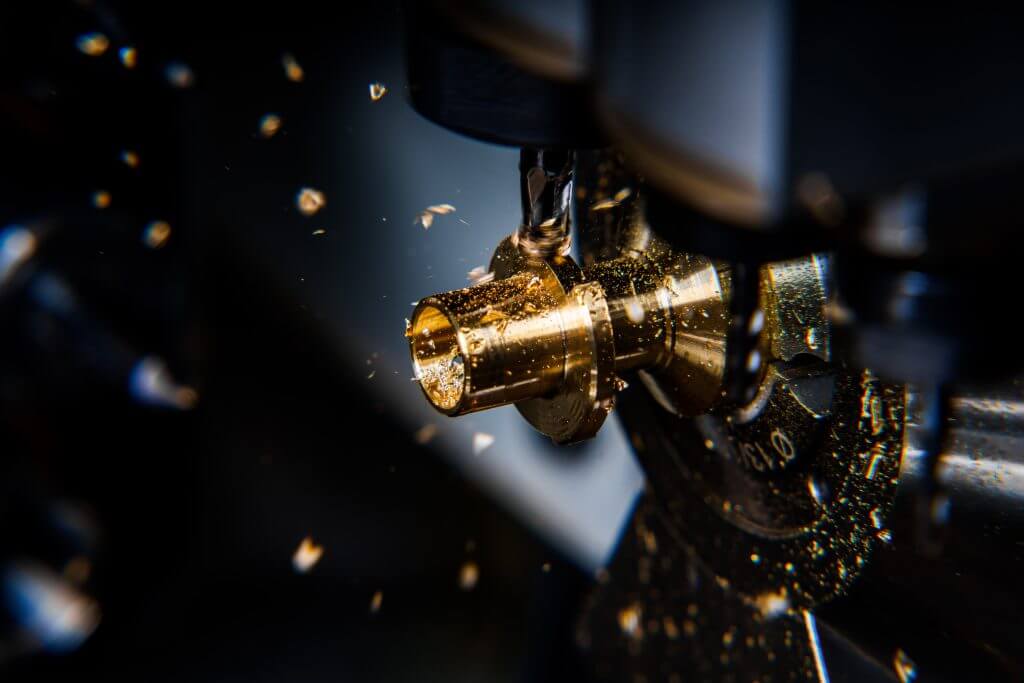
Small Diameter. Impossible Precision.
One Setup.
Swiss-type CNC lathes hold tolerances that conventional turning can't touch — ±0.0001" on parts smaller than a pencil. Guide bushing support eliminates deflection. The bar feeds, the bushing supports, the tools cut. No chatter. No taper. Just repeatable precision at volume.
Swiss-type turning was invented in the watchmaking valleys of Switzerland to produce small, precise components that conventional lathes couldn't hold. The fundamental innovation is the guide bushing — a collet that supports the workpiece immediately adjacent to the cutting zone, eliminating the deflection that makes conventional turning of small-diameter, long parts impossible.
The bar stock feeds through the guide bushing and is always supported within millimeters of where the tool contacts. This means length-to-diameter ratios of 10:1, 15:1, even 20:1 are routine work. A 0.060" diameter shaft 1.5" long? Conventional turning would bend it. Swiss holds it dead straight.
Swiss vs. Conventional CNC Turning
Understanding when Swiss is required versus when a standard CNC lathe suffices is the first decision.
Swiss-Type Guide Bushing
- Guide bushing supports work at the cut zone
- Bar stock feeds through headstock and bushing
- L/D ratios of 10:1 to 20:1 standard
- Typical diameter range: 0.020" to 1.250"
- Multiple tool gangs cut simultaneously
- Sub-spindle enables complete parts in one setup
Conventional CNC Turning Chuck Work
- Workpiece held in chuck, supported by tailstock if long
- L/D limited to ~4:1 without steady rest
- Diameter range: 0.500" to 24"+ typical
- Single-point cutting, sequential operations
- Often requires secondary ops for cross-work
- Better for larger diameters and shorter parts
If the part is under 1.25" diameter and has any combination of tight tolerance, small features, or length — it's Swiss work. If you're making 500 or more, it's definitely Swiss work. The cycle times are unbeatable.
A Swiss machine doesn't just turn a part. It turns it, mills it, drills it, threads it, and cuts it off — all in one cycle, all from bar stock, all lights-out capable. That's why medical device companies run Swiss around the clock.
Swiss Turning Guides
Everything an engineer or procurement team needs to specify, source, and buy swiss turning work.
Tolerance Guide
Production-realistic tolerances by feature type, guide bushing vs. bushingless.
Material Selection
Machinability ratings, bar stock availability, and surface finish by alloy family.
Design for Swiss
Feature access, tool gang limitations, sub-spindle transfers, and DFM rules.
Cost Drivers
How shops price Swiss work. Cycle time, material, setup, and volume economics.
Swiss vs. Conventional
When to use Swiss. Decision matrix by diameter, L/D ratio, and volume.
Applications by Industry
Medical devices, electronics, connectors, automotive, firearms, and hydraulics.
Swiss Turning Titanium
Guide bushing setup, speeds, feeds, and tolerance expectations for Grade 2 and Ti-6Al-4V.
Medical Stainless (316L, 17-4PH)
Production parameters for implant and instrument grade stainless on Swiss lathes.
Medical Device Machining
Processes, materials, tolerances, and FDA/ISO compliance for implants and instruments.