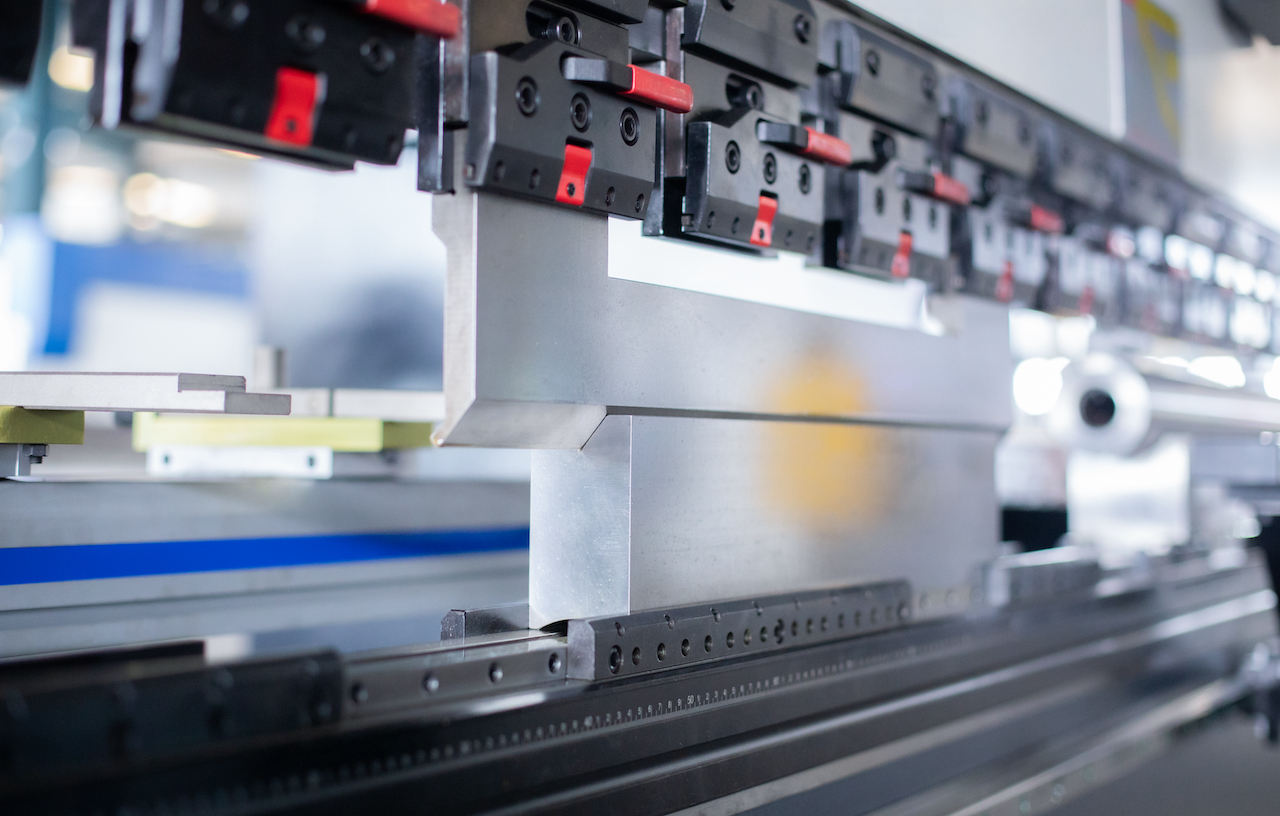
Flat to Formed.
One Machine.
CNC press brakes turn flat blanks into 3D parts — brackets, enclosures, structural members. Angle control to ±0.5°, back gauges to ±0.001", tonnage to bend plate over an inch thick.
Press brake forming uses a punch and die to bend sheet metal along a straight line. The workpiece is positioned against a programmable back gauge that controls bend location, and a CNC-controlled ram drives the punch into the die to form the bend. Modern CNC press brakes store hundreds of programs, manage tool setups automatically, and achieve angular repeatability that manual brakes never could.
The press brake is where flat parts become real. Every bracket, every channel, every enclosure, every structural angle started as a flat blank and became a 3D part on a press brake. It's the most common forming process in metal fabrication and the natural partner to laser cutting — laser makes the blank, brake makes the part.
Air Bending vs. Bottom Bending vs. Coining
Three forming methods on the same machine. Air bending dominates modern CNC brake work.
Air Bending Standard
- Punch presses sheet into die without full contact
- Bend angle determined by punch depth, not tooling
- Same tooling produces any angle from 30° to 180°
- Lower tonnage requirement than bottoming
- Some springback — compensated by CNC over-travel
- 90% of modern CNC brake work uses air bending
Bottom Bending & Coining Precision
- Full contact between sheet, punch, and die
- Angle is set by the die geometry, not depth
- Minimal springback — most repeatable method
- Requires 3–5x more tonnage than air bending
- Separate die required for each angle
- Used for high-precision or thick material forming
Air bending is the default for 90% of brake work because one set of tooling handles any angle. The CNC compensates for springback automatically. Bottom bending and coining come into play when angular tolerance is critical (±0.25° or tighter) or material springback is unpredictable (high-strength steel, thick stainless).
The press brake is the most underestimated machine in fabrication. A good brake operator with a modern CNC can turn a stack of flat blanks into finished parts faster than most people can unfold the drawing. It's not just bending — it's forming, hemming, offsetting, and creating geometry that looks impossible from flat stock.
Brake Press Guides
Everything an engineer or procurement team needs to specify, source, and buy brake press work.
Tolerance Guide
Achievable angle and dimensional tolerances by bend method and material.
Material Selection
Bendability, minimum bend radius, springback, and formability by alloy.
Design for Brake Press
Bend relief, minimum flanges, hole-to-bend clearance, and flat pattern rules.
Cost Drivers
How shops price brake work. Setup, tonnage, complexity, and batch size economics.
Air vs. Bottom Bending
When to use which method. Tonnage, precision, tooling, and cost comparison.
Applications by Industry
Enclosures, structural, HVAC, architectural, furniture, and machine building.
Bending Aluminum Sheet
Minimum bend radii by alloy and temper, springback compensation, and tonnage calculations.