Speed in Feet. Precision in Thousandths.
Edges Ready to Weld.
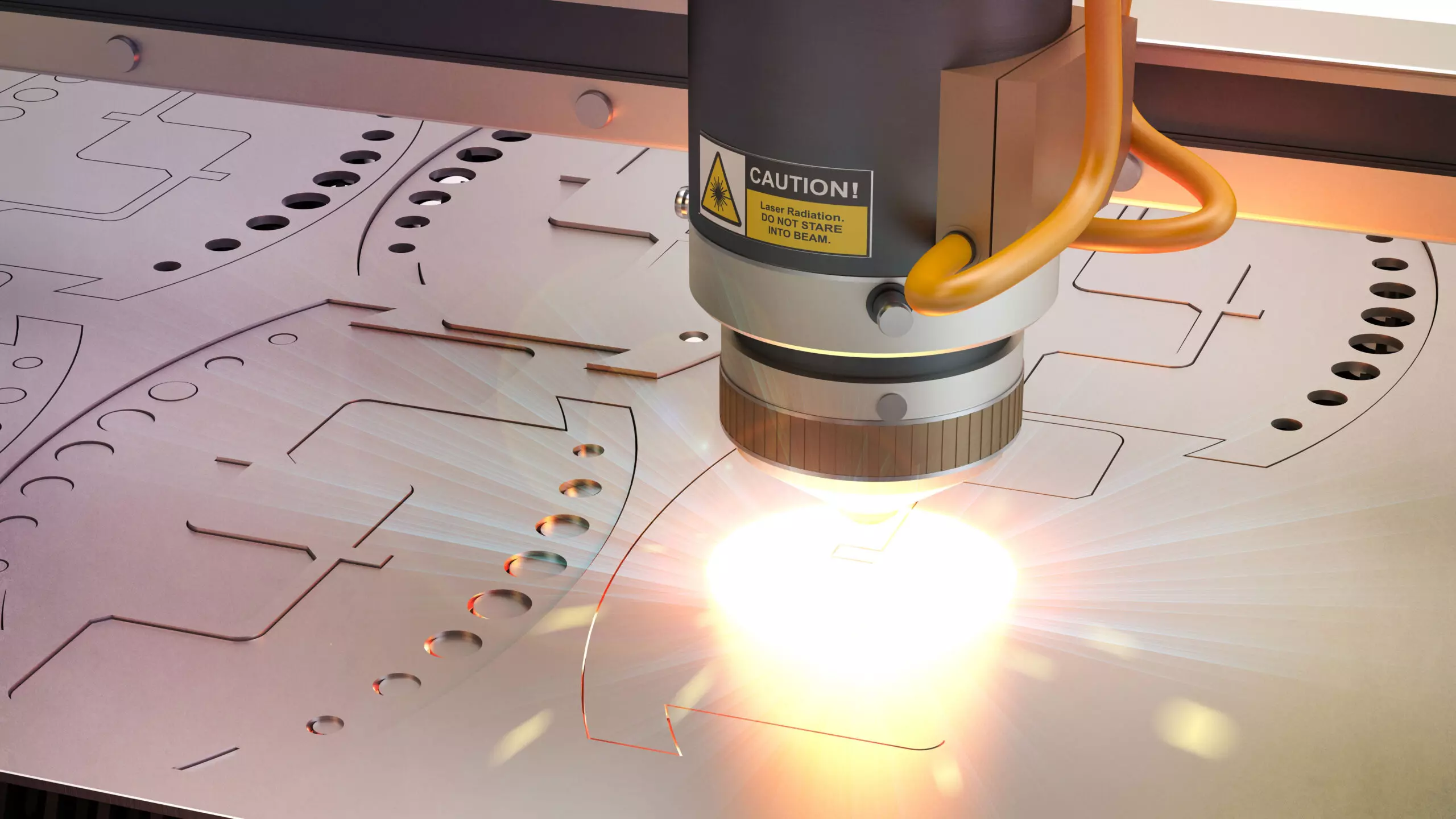
Fiber and CO2 lasers cut sheet metal at speeds no mechanical process can match — 1,000+ inches per minute on thin gauge, ±0.002" accuracy, edges clean enough to weld without grinding. The workhorse of modern metal fabrication.
Laser cutting focuses a coherent beam of light — 1 to 30+ kilowatts — onto a spot smaller than a human hair. The concentrated energy melts, burns, or vaporizes material along a programmed path. An assist gas (nitrogen for clean edges, oxygen for speed on mild steel) blows molten material clear of the cut. The result is a narrow, precise kerf with minimal heat input to the surrounding material.
Modern fiber lasers have revolutionized the industry. 10x faster than CO2 on thin material, lower operating cost, virtually maintenance-free resonators, and the ability to cut reflective materials like copper and brass. A 10kW fiber laser cuts 0.250" mild steel at over 300 inches per minute. That speed translates directly to cost — laser parts are cheap when they're thin.
Fiber vs. CO2 Laser
Two technologies, different wavelengths, different strengths. Most shops are migrating to fiber.
Fiber Laser 1.07 μm
- Solid-state resonator — no gas, no mirrors, no alignment
- 5–10x faster than CO2 on thin material (< 0.250")
- Cuts copper, brass, bronze (CO2 cannot)
- 40–50% less electrical consumption than CO2
- 100,000+ hour diode life vs. CO2 gas refills
- Struggles with thick acrylic and some non-metals
CO2 Laser 10.6 μm
- Gas resonator — mature, well-understood technology
- Superior edge quality on thick material (1"+)
- Cuts acrylic, wood, fabric, and organic materials cleanly
- Better beam quality for very thick metal cutting
- Higher operating cost (gas, mirrors, maintenance)
- Being displaced by fiber for most metal cutting
If the work is metal under 1" thick, fiber laser is the answer 95% of the time. It's faster, cheaper to operate, and handles reflective materials that CO2 can't. CO2 still owns thick metal, non-metal cutting, and a few edge-quality niches — but the industry is going fiber.
Laser cutting is the process that turned custom metal parts from a specialty into a commodity. What used to take a day of sawing, drilling, and grinding now takes minutes of unattended cutting. That's why every job shop and fab house has at least one.
Laser Cutting Guides
Everything an engineer or procurement team needs to specify, source, and buy laser cutting work.
Tolerance Guide
Production tolerances by material and thickness. Kerf, hole accuracy, and flatness.
Material Selection
Cut speed, edge quality, and max thickness by material type and laser source.
Design for Laser
Minimum features, tab design, bend allowance integration, and DXF best practices.
Cost Drivers
How shops price laser work. Machine time, material, nesting, and volume breaks.
Fiber vs. CO2
When to use which technology. Speed, quality, material, and cost comparison.
Applications by Industry
Job shop, HVAC, enclosures, automotive, structural, and decorative work.
Laser Cutting Stainless Steel
Thickness limits by laser power, edge quality, and nitrogen vs oxygen assist gas selection.