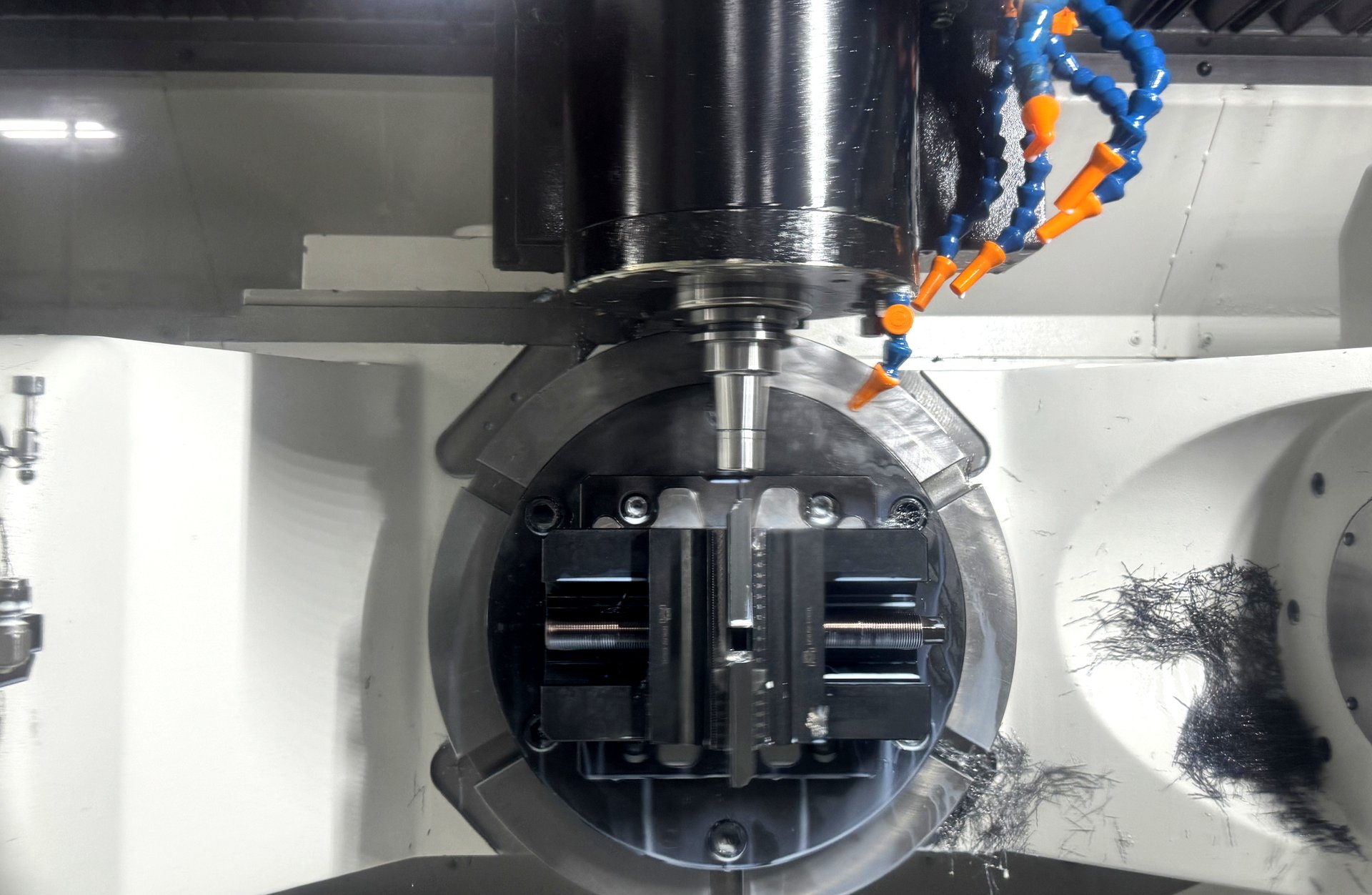
Four Setups Become One.
That's the Point.
5-axis machining reaches every face of a complex part in a single clamping. Fewer setups, tighter tolerances, shorter lead times — from shops with the machines and the open capacity to take your work.
Conventional 3-axis milling moves the tool in three linear directions — X, Y, and Z. The tool always points straight down. This limits access to features that aren't on the top face, which means multiple setups, custom fixtures, and tolerance stack-up from re-positioning.
5-axis machining adds two rotational axes, allowing the tool to approach the workpiece from virtually any angle. A part that requires four setups on a 3-axis mill can often be completed in one setup on a 5-axis machine. One clamping. One datum. One setup.
Two Kinds of 5-Axis. Know the Difference.
Most parts quoted as "5-axis work" don't actually need simultaneous 5-axis. The distinction changes the cost.
Simultaneous Continuous
- All five axes move at the same time during cutting
- Tool orientation changes continuously along the toolpath
- Required for sculpted surfaces, impellers, turbine blades
- Complex CAM programming — higher programming cost
- Machine must have high dynamic accuracy
- Highest capability, highest cost per hour
3+2 Positional Indexed
- Rotary axes position the part, then lock during cutting
- Cutting is still 3-axis — just from an angled orientation
- Eliminates multiple setups and custom fixtures
- Simpler programming than full simultaneous
- Most 5-axis work is actually 3+2
- Lower cost than simultaneous for prismatic features
If your part has prismatic features on multiple faces but no sculpted surfaces, 3+2 gets you the same result at lower cost. Ask your shop which approach they recommend before assuming you need full simultaneous. The answer will change your quote.
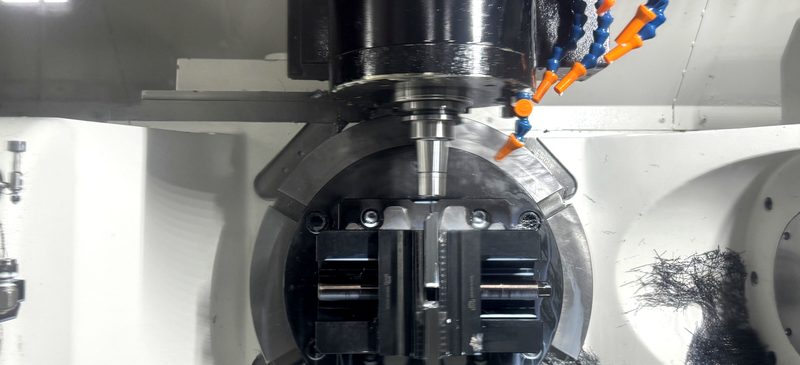
The value of 5-axis isn't the machine. It's the setup you didn't have to make, the fixture you didn't have to build, and the tolerance you didn't lose to re-clamping.
5-Axis Guides
Everything an engineer or procurement team needs to specify, source, and buy 5-axis machining work.
Tolerance Guide
Simultaneous vs 3+2 accuracy, positional repeatability, thermal effects.
Simultaneous vs. 3+2
When you need full simultaneous and when 3+2 gets you the same result.
Material Selection
Aluminum, titanium, Inconel, stainless, plastics. Strategy and cost by material.
Design for 5-Axis
Undercuts, thin walls, deep pockets, datum strategy, tool access.
Cost Drivers
Machine rates, programming time, fixturing, and the setup count advantage.
Applications by Industry
Aerospace structural, turbine, medical implants, defense, motorsport, energy.