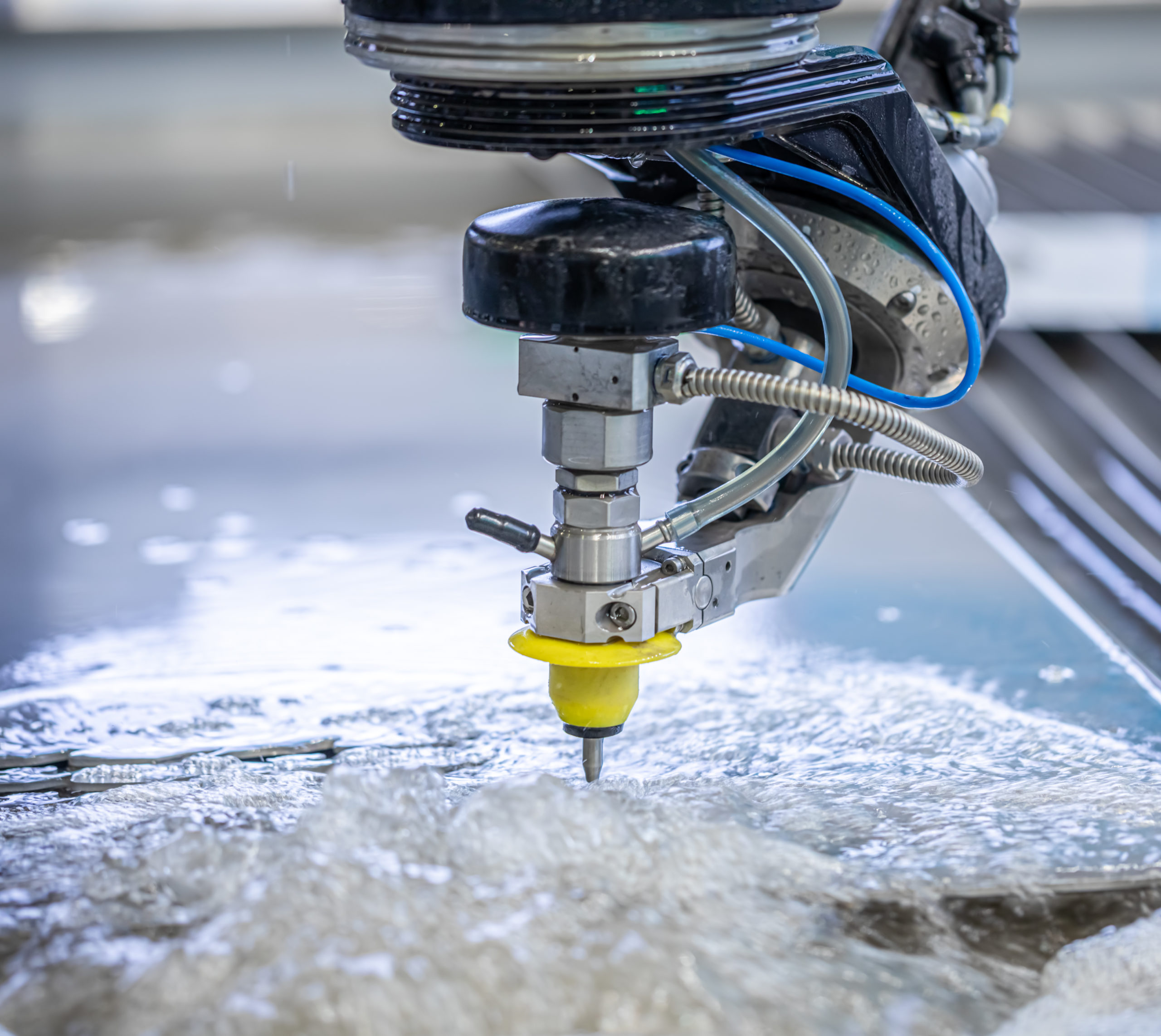
Any Material. Any Thickness.
No Heat.
Abrasive waterjet cuts with a supersonic stream of water and garnet — 60,000 PSI focused through a sapphire orifice. No heat-affected zone. No thermal distortion. No material limitation. If it exists, waterjet cuts it.
Waterjet cutting uses ultra-high-pressure water mixed with abrasive garnet particles to erode material along a programmed path. The cutting stream is approximately 0.030" to 0.050" in diameter, traveling at Mach 3. Material is removed by erosion, not melting — which means there is zero thermal input to the workpiece.
This absence of heat is the defining advantage. No heat-affected zone. No metallurgical change. No thermal stress. No warping. Waterjet cuts hardened tool steel and leaves the hardness unchanged. It cuts titanium without alpha case. It cuts composites without delamination. It cuts tempered glass without shattering.
Abrasive vs. Pure Waterjet
Abrasive waterjet uses garnet to cut hard materials. Pure waterjet cuts soft materials with water alone.
Abrasive Waterjet Hard Materials
- Water + garnet abrasive at 60,000 PSI
- Cuts metals, stone, glass, ceramics, composites
- Thickness capacity: 0.010" to 12"+ in steel
- Kerf width: 0.030"–0.050" typical
- Tolerances: ±0.003"–0.005" production
- Slower on thick material — speed drops with thickness
Pure Waterjet Soft Materials
- Water only — no abrasive added
- Cuts foam, rubber, gasket, food, textiles, paper
- Much faster than abrasive on compatible materials
- Kerf width: 0.010"–0.015" (thinner)
- No abrasive cost — lower operating expense
- Cannot cut metals, stone, or hard materials
If you can scratch it with garnet sandpaper, abrasive waterjet will cut it. If it's soft enough to cut with a pressure washer, pure waterjet handles it. There is no material on earth that waterjet cannot cut — including diamond.
Waterjet is the only process in manufacturing with literally zero material restrictions. Titanium, granite, bulletproof glass, carbon fiber, stacked dissimilar metals — it cuts all of them without changing a single material property.
Waterjet Cutting Guides
Everything an engineer or procurement team needs to specify, source, and buy waterjet cutting work.
Tolerance Guide
Edge quality levels, taper control, and production-realistic dimensional accuracy.
Material Selection
Cut speed, edge quality, and cost across metals, composites, stone, and glass.
Design for Waterjet
Kerf compensation, tab design, nesting, pierce points, and stack cutting.
Cost Drivers
How shops price waterjet work. Machine time, abrasive, material, and nesting efficiency.
Waterjet vs. Laser
When to use which process. Thickness, material, tolerance, and cost comparison.
Applications by Industry
Aerospace, architecture, automotive, art, and industrial fabrication.
Waterjet Cutting Titanium
HAZ-free cutting speeds by thickness, edge quality, taper control, and cost analysis.